




Programs
Undergraduate program
B.Sc. (Food Technology)
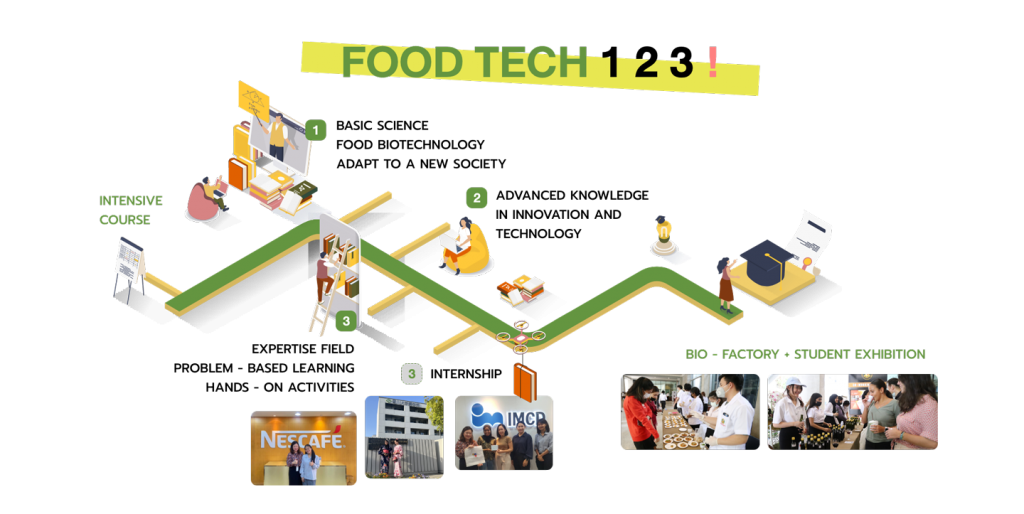
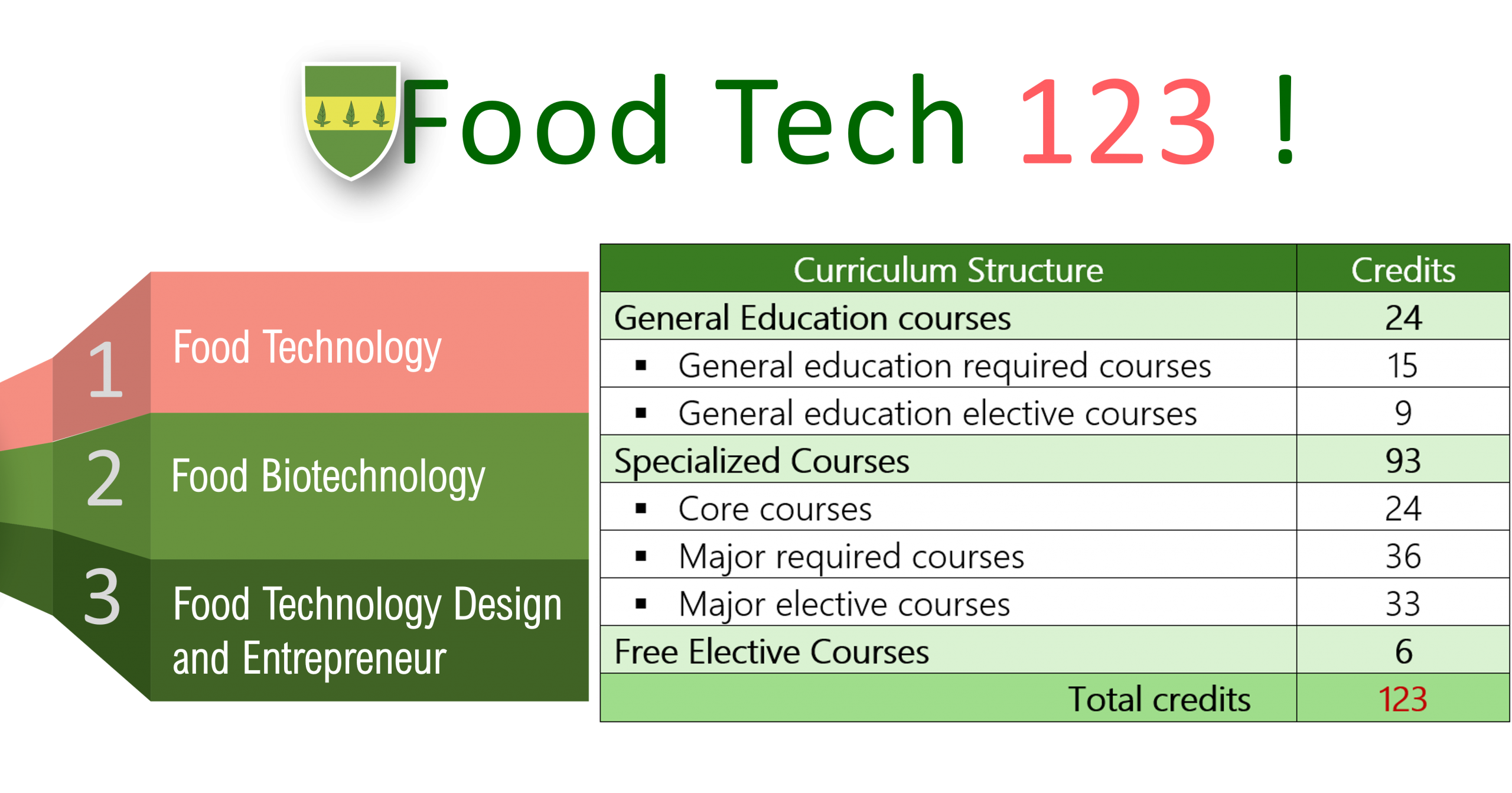
At Theophane Venard School of Biotechnology, the undergraduate program is designed to serve the current hiring trend for S-curves industry, specifically in the field of Food Biotechnology. The total credits for bachelor’s degree is 123 credits which allow students to graduate within 3 years. Students spend the first two years of study developing the scientific and general background necessary for their experience in sciences. The foundation in basic sciences include chemistry, biology, physics, and fundamental knowledge in Food Technology such as nutrition, food microbiology, food chemistry, food analysis, food commodities, food processing, and food engineering. In their third year, as students realize what they want to pursue, there are 3 concentrations offered by the school to select on which are
- Food Technology
- Food Biotechnology
- Food Technology Design and Entrepreneur
Undergraduate Advising
The Advising System at Theophane Venard School of Biotechnology aims to help the students with registration, practical training and funding, academic and student activities, and student’s special projects. Every student will be assigned to a faculty member to guide them throughout their study at Assumption University.

1st Semester
97,700 THB

Full Program
3 Years
667,750 THB
*Approximate Fees*
Remark: The aforementioned fees may be subject to change without period notice.
CAREER OPPORTUNITIES
Research & Development
- Researcher in laboratory
- Flavorist trainee
- Senior R&D supervisor
- Food R&D officer
- R&D specialist
- R&D and QA manager
- R&D director
Sales & Marketing
- Bio-entrepreneur
- Import-Export sales
- Sales executive
in food ingredients - Sales executive
in enzymes - Technical sales manager
- Sales representative
- Food service sales executive
- Food scientist
Quality Control (QC)
and Auditor
- International standard auditor
- Senior QC supervisor
- QC supervisor
- Supplier audit and development supervisor
- Quality management team lead
Specialist
- Nutritionist
- Sport nutritionist
- Dietitians
- Lecturers
- Sensory analyst
- Geneticist
- Chef
Advising steps
At the beginning of the first academic year. School’s office will arrange a new advisee to an advisor. To find out who is your advisor, please contact the advisory office located at E34/1 FBI-ABAC Office.
Every student must meet their advisor twice a semester, before and after the midterm examination. Failure to do so will result in no access to registration for a new semester. The advisors can be reached via AU Spark or during their office hours posted in front of their offices.
The advising system of the school is conducted in an open-door manner that allows the students to feel free to meet with the advisor any time. Students are encouraged to consult with the advisor on any academic topic or how to adjust to life in the university.
Q & A
Q: If I have no background in basic science, can I still apply for this School?
A: Yes, by studying Food Technology every student gets an exposure to a wide range of scientific disciplines and has a chance to succeed in more areas. Food Technology courses then ask students to apply principles learned in general science classes to the science of food production.
Q: What is the idea of internship? How should I know where to go?
A: Internship can guide you towards you career path in the future. It involves 200-hour training during the summer break of students’ third year. Before choosing where to head, students can join the presentation made by their seniors who just got back from their internship. Internship can be done at a scientific laboratory, food-related or biotech-related factory, governmental agency, or even a farm! Domestically or internationally is acceptable.
Q: Can I use this major in my preparation for professional school, medical school, etc.?
A: The Food Technology major provides enough rigor for further educational advancement in graduate or professional schools. Students will obtain the B.S. degree in Food Technology. Thus, if the Grad school requires B.S. degree, the students are applicable. We have some of the alumni who graduated here and successfully continued for medical schools or switching to pharmaceutical area.
Q: Will I be immediately employable after completion of a Bachelor of Science (B.S.) degree in these majors?
A: Yes. Our students have no difficulty in obtaining employment throughout the food industry. Companies such as CP enterprises, Nestl
Q: What else do I do besides attend classes? Should I join extra-curriculum activities?
A: Definitely! At Assumption University, there are many clubs, sports activities, and events for you to join. Although most of them may be located at Suvarnabhumi campus, it is still tempting to join such many activities. This will shape your soft skills to be ready for your future. You also have opportunity to developing leadership skills by serving as a staff at the Assumption University Student Organization (AUSO), or by organizing club activities.
Q: What are some of the differences between Food Biotechnology, Nutrition and Culinary Science?
A: Food Biotechnology deals with the science and technology which is required to produce food from agricultural commodities. Food Science ensures a safe food supply. Proper storage and processing prevent the transfer, or the production, of toxicants. Biotechnology creates new, innovative, useful foodstuffs by manipulation of biological source materials. Sensory science allows consumer testing and product research. Quality control maintains production standards. Engineering develops new methods of processing, and perhaps even new ways to make familiar foods.
Q: If I major in Food Technology, must I always remain a food scientist? Isn’t this a narrow career option?
A: Here we will teach you to be more than a scientist. The curriculum is emphasized on the AU Identity of graduates (3E: Ethics, English Proficiency and Entrepreneurial Spirit). Our graduates will automatically absorb the business perspective from the University to develop their entrepreneurial spirit. With the other 2Es, Ethics and English Proficiency, graduates are not only able to work in the food production factory. You can have a career path in technical sales, marketing, distribution, plant supervision, product development. You might even form your own company.